The Evolution of Work Towards Portfolio Careers – Why Leveraging Your Expertise Matters More Than Ever

The world of work is no longer changing. It has already changed. Yet surprisingly many professionals are still building their careers according to rules that were created for a completely different era.
When people talk about the future of work, the conversation often revolves around artificial intelligence, remote work or talent shortages. While these are important topics, they are only symptoms of a much larger transformation.
The real shift lies in how value is created, how expertise is bought, and how professionals build their careers.
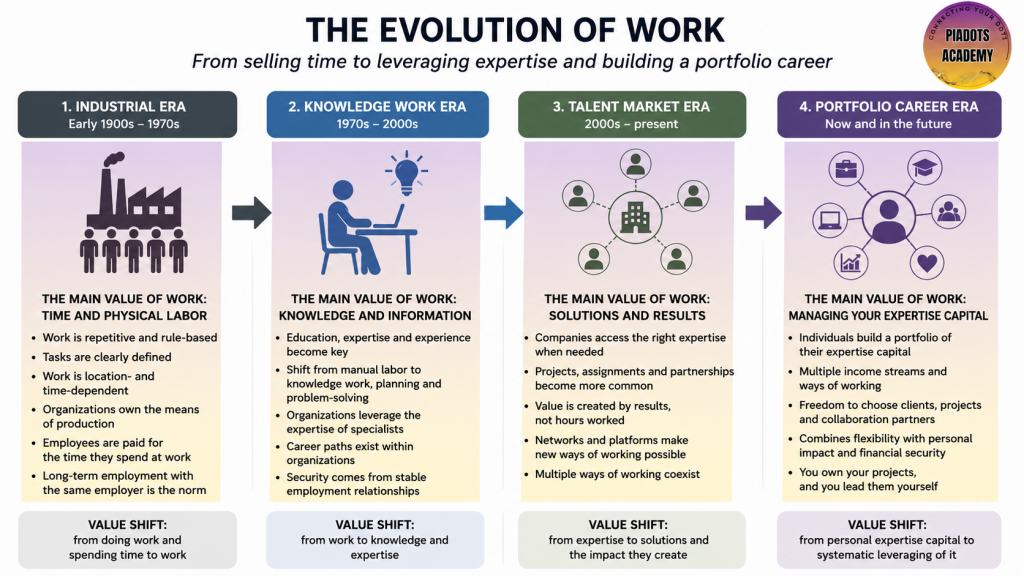
The infographic illustrates this evolution.
From the Industrial Era to Knowledge Work
During the Industrial Era, work was primarily about time and physical labor. Organizations owned the means of production, employees worked in fixed locations during fixed hours, and long-term employment with a single employer was considered the ideal career path.
As economies evolved, knowledge became the new competitive advantage.
Education, expertise and experience became increasingly valuable. Organizations hired specialists to solve complex problems, develop products and improve business performance. Although the work itself changed dramatically, careers were still largely built around permanent employment.
Welcome to the Talent Market Era
Today we have entered what I call the Talent Market Era.
Companies no longer buy working hours as their primary resource. Instead, they buy solutions, expertise and measurable outcomes exactly when they need them.
At the same time, professionals have more opportunities than ever to offer their expertise through different forms of work.
Interim management, fractional leadership, consulting, freelancing and project-based assignments are no longer exceptions. They have become legitimate and increasingly common ways of creating value for organizations while giving experts greater flexibility in their own careers.
This represents a fundamental shift.
Competitive advantage is no longer created simply by what you know. It is created by how effectively you leverage your expertise.
Why I Talk So Much About Portfolio Careers
This is exactly why I spend so much time talking about portfolio careers, interim leadership, fractional roles, consulting, freelancing and different ways of selling expertise.
Not because everyone should become an entrepreneur. Not because everyone should have multiple jobs at the same time.
But because more professionals need to understand that expertise can create value in many different ways.
For me, a portfolio career is not a job title.
It is a mindset.
Instead of depending entirely on one employer, one role or one income stream, professionals learn to actively manage their expertise as their most valuable asset.
The same individual may combine permanent employment, interim assignments, fractional leadership, consulting, coaching, teaching, writing books or building online courses.
The objective is not to do everything simultaneously.
The objective is to understand where your expertise creates the greatest value and how it can be applied in different contexts throughout your career.
The Next Competitive Advantage
Many people believe that the next competitive advantage will come from another degree, another certification or an even longer résumé.
I disagree.
The next competitive advantage is the ability to identify, position, productize and strategically manage your expertise capital.
As organizations become increasingly outcome-driven, professionals who clearly communicate the problems they solve and the value they create will stand out regardless of whether they work as employees, consultants, interim executives or entrepreneurs.
Is There Really a Talent Shortage?
I have said this many times, and I continue to believe it.
I don’t believe Finland (or world in general) has a genuine talent shortage. I believe we have a shortage of effectively utilizing expertise.
We have highly educated professionals, but too often their expertise remains invisible, poorly positioned or difficult for organizations to buy.
At the same time, companies struggle to find the right people because they continue looking through traditional employment models when the expertise they need may already exist in new forms of collaboration.
That is why I believe the most important conversation over the next decade will not be about which professions disappear or which degrees become more valuable.
The real question is:
How can professionals leverage their expertise in a rapidly evolving world of work?
Final Thoughts
The evolution of work cannot be stopped but we can choose how we respond to it.
Professionals who learn to recognize their expertise, communicate its value, productize it and leverage it through different forms of work will be better prepared for whatever comes next.
The future belongs to those who actively manage their expertise—not simply those who possess it.
About the Author
Pia Kiviranta is a Portfolio Career Coach, commercialization of expertise specialist, interim and fractional executive, consultant, author, LinkedIn educator and founder of PiaDots Oy.
She helps professionals, executives and organizations identify, productize and commercialize expertise while navigating the changing world of work. Through coaching, consulting, online education and thought leadership, she advocates for more flexible ways of working and believes that the future belongs to those who learn how to strategically leverage their expertise capital.
Connect with Pia:
- 🌐 PiaDots Interim: https://piadotsinterim.fi
- 🌐 PiaDots Academy: https://piadotsacademy.fi
- 💼 LinkedIn: https://www.linkedin.com/in/pia-kiviranta-portfoliocareercoach/